Koror, Republic of Palau
Palau Community College (PCC) was founded in 1969 as a two-year post-secondary vocational/technical institution. It grew out of a trade school that had its beginning in 1927 during the Japanese administration prior to World War II. PCC began with a small group of students enrolled in one vocational program on a campus with limited physical facilities. It was known at that time as Micronesian Occupational Center.
The expansion of vocational education resulted from such factors as a growing political awareness, articulation among the states/republics of Micronesia, and a greater commitment to educational and economic development by the United States of America. Funding permitted the addition of facilities and staff so that by 1976, training programs were provided in more than twenty specific vocational areas grouped into ten trade clusters. The goal of a post-secondary institution for vocational education to prepare students with necessary skills and knowledge needed in a developing and expanding economy has not changed through the years.
Until 1977, the Micronesian Occupational Center and the Community College of Micronesia were two autonomous post-secondary institutions serving Micronesia. On March 29, 1977, Trust Territory Public Law No.7-29, amended later by Public Law 7-130, created the College of Micronesia as a public corporation under its own Board of Regents. The law, which took effect on October 1, 1977, joined into a single post-secondary educational system the Micronesian Occupational Center and the Community College of Micronesia, which included the CCM-affiliated School of Nursing. In May 1978, Micronesian Occupational Center officially became Micronesian Occupational College, a distinct and complementary part of the College of Micronesia. In September 1987, a treaty among the Republic of the Marshall Islands, the Federated States of Micronesia, and the Republic of Palau regarding the College of Micronesia was executed establishing a complete autonomy of each college in the COM system to local governments. The treaty was terminated on March 31, 1993, which laid the foundation for Palau Community College.
On March 19, 1993, the Republic of Palau President, Kuniwo Nakamura, signed into law RPPL 4-2 (Higher Education Act of 1993), establishing Palau Community College.
On April 2, 1993, Micronesian Occupational College officially became Palau Community College.
Alvina Timarong, Chairperson
Governor Emais Roberts, MD, Vice Chairperson
Palau representative to the College of Micronesia Board of Regents (COM-BOR), currently serving as Chairman
Romana Wong, Secretary/Treasurer
Leoben Teriong, Trustee
Kara Rechelulk, Student Trustee
VISION STATEMENT – Where We Want to Be
“We strive to guarantee quality and excellence”
MISSION STATEMENT – Who We Are and What We Do
Palau Community College is an accessible comprehensive public educational institution helping to meet the technical, academic, cultural, social, and economic needs of students and communities by promoting learning opportunities and developing personal excellence.
UNIFYING PRINCIPLES – How We Behave
Unifying principles are highly valued statements or beliefs which form the basis for policy setting, planning, our daily interaction with one another and our decision making. They serve as cornerstones on which we build a successful institution.
Palau Community College believes in:
Oba Tal Tekoi – Teamwork
Kot el Ngarbab el Omeruul – Quality Services
Diak a Berrotel – Open Communication
Ulterekokl el Olengcheled – Managing with Goals
Oldubech a Kedul a Dereder – Promoting Leadership
Melemalt e Melangesmad – Integrity and Loyalty
Tekoi el Buai – Community Ownership
Ouelangch ra Melemolem el Klungiaol – Continuous Improvement
Seberakl, Chituuk, e Melasem a Tekoi – Creativity and Innovation
Omengull ra Tang ma Tang – People and Respect for Others
PCC is located in Koror, Palau. Geographically, Palau is part of Micronesia which was administered by the U.S. as the Trust Territory of the Pacific Islands after World War II, from 1955 to 1994. In 1994, the Republic of Palau entered into a Compact of Free Association with the U.S. This vast ocean area of some 3 million square miles – roughly the size of the continental U.S. is located just above the equator in the Western Pacific Ocean.
Koror is located about 500 miles east of Manila, 800 miles southwest of Guam, and 10,000 miles west of Washington, D.C. PCC is therefore the most distant and remote member of the U.S. family of colleges and universities.
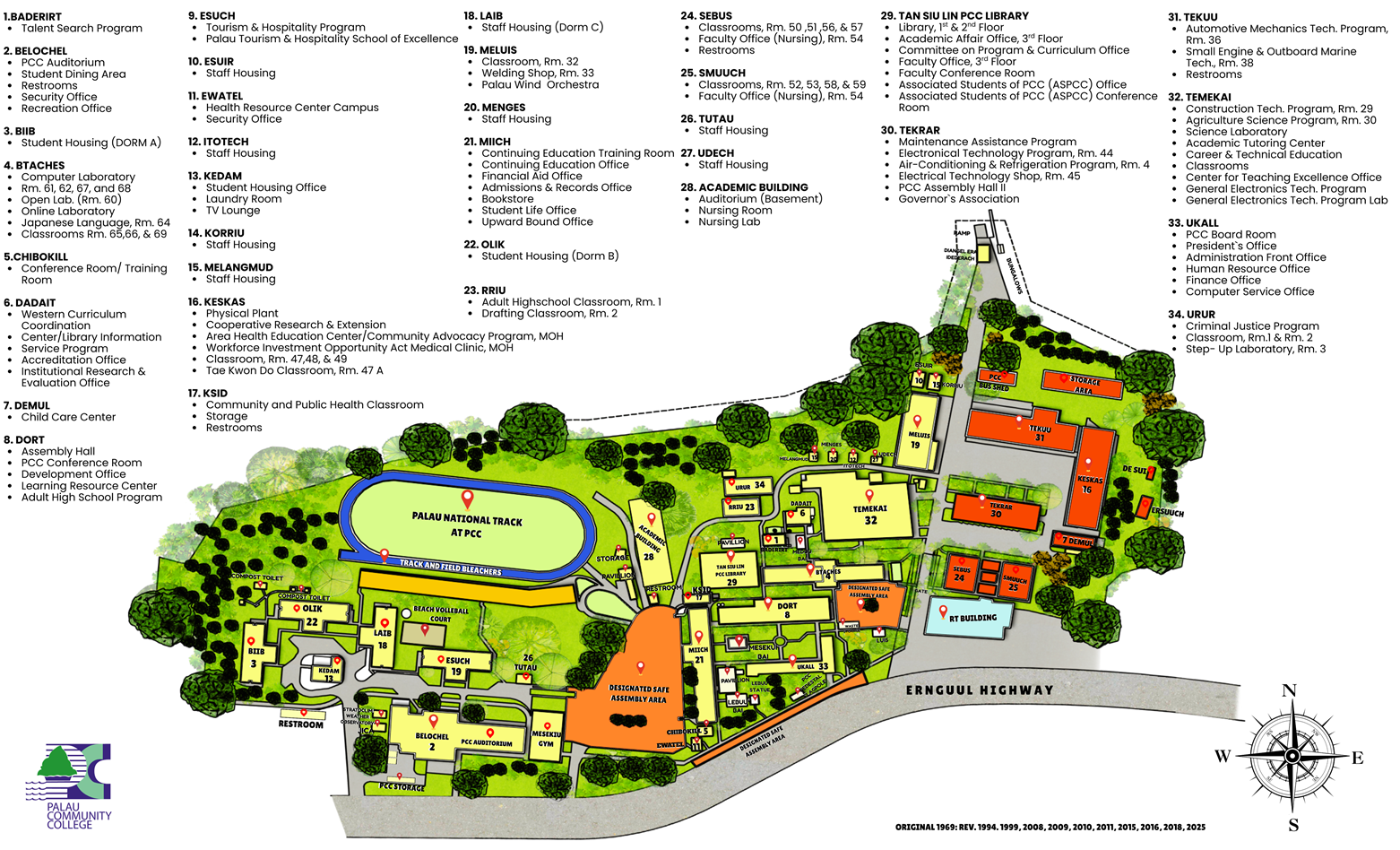
Palau Community College is conveniently located in downtown Koror, within walking distance of businesses and government offices.